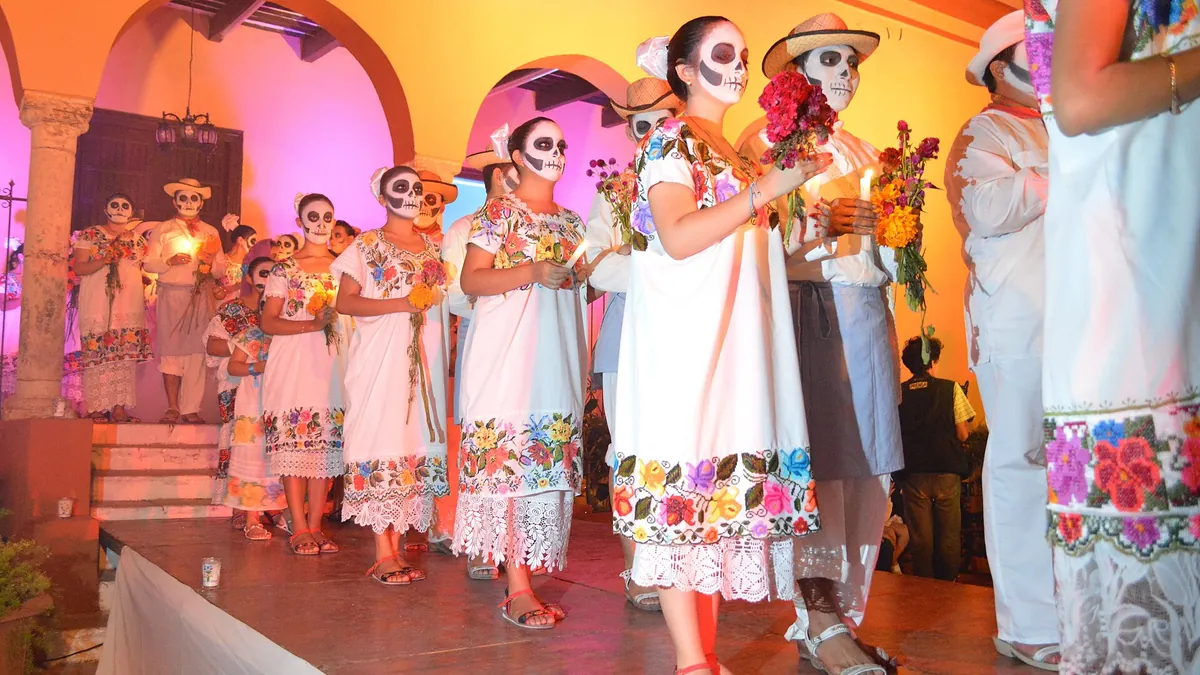
By the middle of October, you start to see it. Marigolds at the market stalls. Sugar skulls in the bakery windows. Paper banners going up across the streets. Day of the Dead is still weeks away, and the region is already getting ready.
Here is the news. Cozumel has announced the return of its Day of the Dead festival, with Michoacán as guest of honor. Isla Mujeres has presented the program for its Light and Life 2026 festival, with Pandora and catrinas among the announced highlights. Both are reported by Riviera Maya News & Events.
The Michoacán connection is the detail to appreciate. That state, in western Mexico, is home to some of the most famous Day of the Dead observances in the country, particularly around Lake Pátzcuaro, where families keep candlelit vigils in the cemeteries through the night. Bringing those traditions to a Caribbean island puts two very different regional cultures side by side.
Perception vs. reality
Many visitors arrive thinking of Day of the Dead as a Mexican version of Halloween. It is a different thing entirely. It is a family occasion, warm and often joyful, built on the belief that the dead return for a short visit and should be welcomed with the things they loved in life. There are costumes and painted faces at the public events. At its heart, though, are the home altar, the photograph, the favorite dish and the visit to the grave.
What it means in the real world
A first-time visitor who happens to be here in late October gets one of the best cultural experiences Mexico offers, at no cost, simply by walking through town. A long-term resident often ends up building an altar of their own, sometimes for a parent or a pet, and finds it more moving than they expected. A family with children will find the public events welcoming and the imagery far less frightening than it looks in photographs. Anyone planning a trip around the date should book early, since it has become one of the busier weeks of the autumn.
Hanal Pixán: the Maya tradition
In the Yucatán Peninsula, the season has its own name and character. Hanal Pixán means "food for the souls" in Maya. Traditionally, October 31 is for the souls of children, November 1 for adults and November 2 for all souls. Families set a table with candles, flowers, water and food. The centerpiece is mucbipollo, also called pib, a large tamal of corn dough and meat, wrapped in banana leaves and baked in a pit in the ground. You will find it at markets and bakeries across Playa del Carmen in the last days of October, and it is well worth trying.
Fast facts
- Main dates: November 1 and 2, with events in the days before.
- Cozumel: Day of the Dead festival returns, with Michoacán as guest of honor.
- Isla Mujeres: Light and Life 2026 festival; program announced.
- Local tradition: Hanal Pixán, the Maya observance, October 31 to November 2.
- What to eat: mucbipollo (pib) and pan de muerto.
- What to look for: altars, marigolds (cempasúchil), catrinas and candlelit processions.
- Check before you go: dates and times in each festival's published program, which we have not independently confirmed.
Everyday life in the season
In Playa del Carmen, schools, businesses and neighborhoods build altars, and you will see them in hotel lobbies, restaurants and shop windows. The municipality traditionally stages public events downtown. Just south of the city, Xcaret park holds its long-running Festival of Life and Death Traditions around the same dates. On the evening of November 2, the cemeteries fill with families, flowers and music. Visitors are generally welcome to observe, quietly and respectfully.
Where this actually is
All of these are within easy reach of Playa del Carmen. Cozumel is a ferry ride of approximately 40 minutes from the downtown pier. Isla Mujeres is reached by ferry from Cancún, about an hour north by road (approximate), followed by a short crossing. It is possible to see celebrations in two or three places over the long weekend with a little planning.
What the headlines don't have room for
International coverage of Day of the Dead usually shows Mexico City's parade or the cemeteries of Michoacán and Oaxaca, and those are spectacular. What it seldom shows is how the tradition is kept in smaller places, by ordinary families, with regional differences like Hanal Pixán. Seeing it here, at neighborhood scale, is a more personal experience.
How to think about your own decision
If you are choosing travel dates, the last week of October through November 2 is a rewarding time to be here. If you live here, consider building an altar; your neighbors will be glad to explain what goes on it. If you want to attend the island festivals, look up the programs now and plan your ferries. We will publish Playa del Carmen's own schedule as soon as it is announced.
Key terms
- Ofrenda — the altar built to welcome the dead, with photographs, candles, flowers and food.
- Cempasúchil — the orange marigold whose scent and color are said to guide the souls home.
- Catrina — the elegant skeleton figure that has become the symbol of the celebration.
- Hanal Pixán — the Maya observance of the season in the Yucatán Peninsula.
Frequently asked questions
November 1 and 2, with Hanal Pixán observances beginning October 31 and public events in the days before.
In Playa del Carmen itself, on Cozumel, on Isla Mujeres and at Xcaret park.
Yes. Public events are open to everyone. In cemeteries, be respectful and ask before taking photographs of people.
Hanal Pixán is the Maya form of the observance in the Yucatán Peninsula, with its own foods and customs, especially mucbipollo.
Yes. It is a family occasion, and many events are designed with children in mind.
Sources & further reading
Sources: Cozumel's festival and guest of honor — Riviera Maya News & Events; the Isla Mujeres program — Riviera Maya News & Events. Travel times are approximate. Descriptions of traditions are general cultural background.
More on culture and seasons here in our Playa del Carmen lifestyle guide.